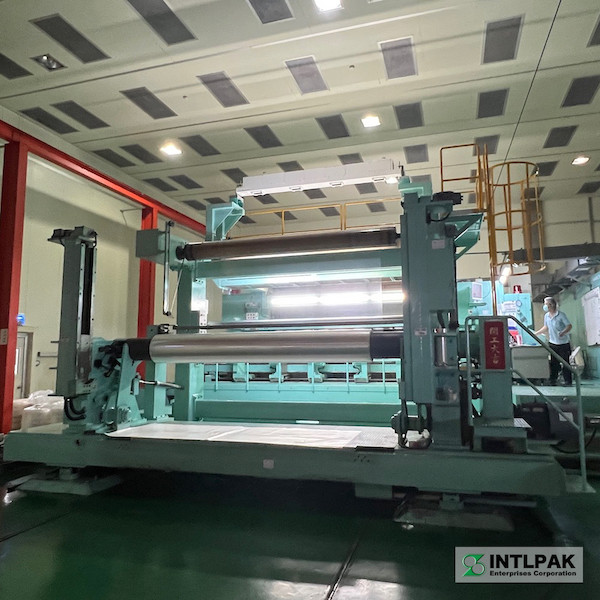
Product Photo
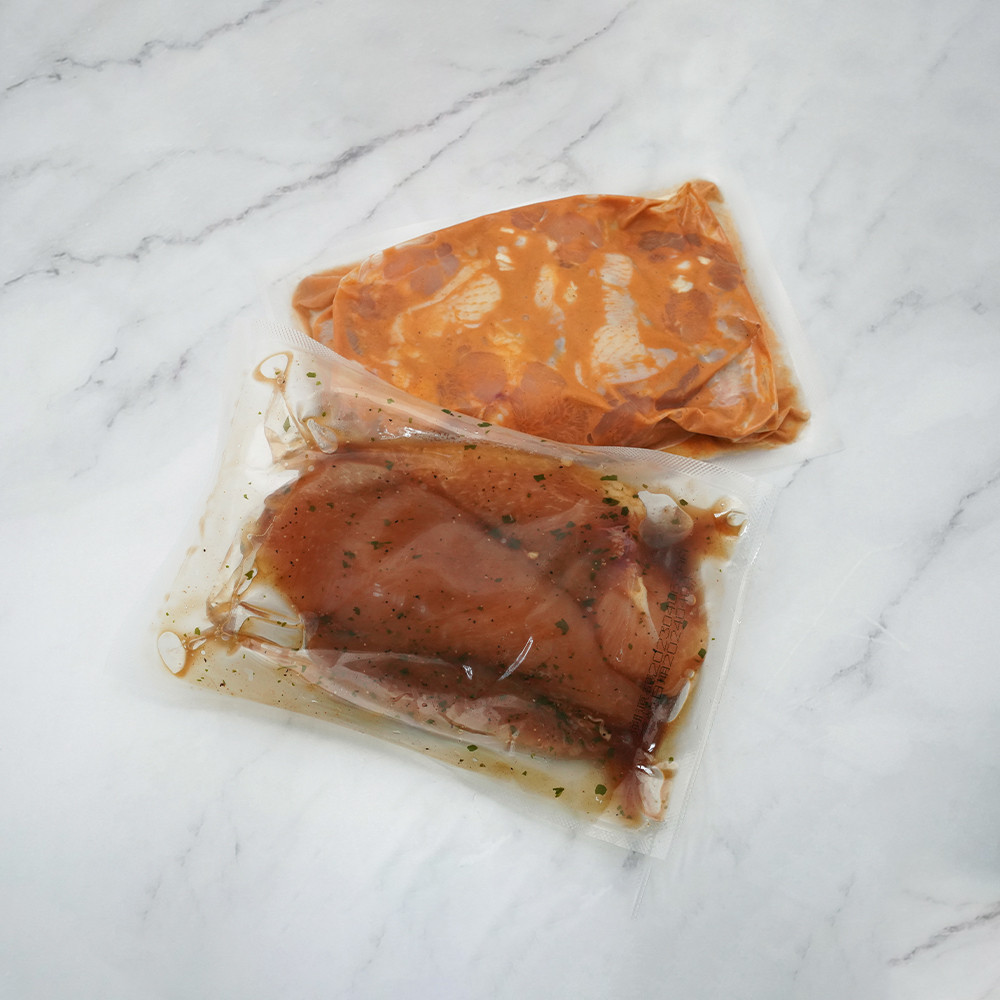
Nylon Thermoforming Film — Food Package
NL180 NY/PE thermoforming film used as a sealing/forming film on continuous automatic vacuum thermoforming lines, built for an extra-deep 60–70mm forming depth. Laminates with PET or OPP film to form a vacuum bag for chicken, ham, sausage, bacon, duck, meat, and seafood.
An Extra-Deep-Draw Gauge for the Bulkiest Cuts
F2647 is the 180μm grade in Intlpak's NL series, built for a 60–70mm forming depth — the deepest cavity in the mid-family lineup, for whole primal cuts, large bone-in joints, and multi-piece bulk packs. It delivers the family's highest elongation (620%/600% MD/TD) to absorb the stretch of a deep draw, with a corona-treated NY surface for dependable lamination bonding.
Where F2647 Is Used
- 1 Extra-deep-draw vacuum packaging film for refrigerated and frozen food, 60–70mm forming depth
- 2 Whole primal cuts of beef and pork, and large bone-in poultry portions
- 3 Whole ham, large bacon slabs, whole duck, and other bulky processed meats
- 4 Large-format or multi-piece seafood and meat packs requiring maximum cavity volume
- 5 Extra-deep-draw sealing/forming film on continuous automatic vacuum thermoforming lines
Full Specifications — Thermoforming Nylon/PE Film Series
F2647 is the 180μm, 60–70mm forming-depth grade in Intlpak's NL nylon/PE thermoforming film family. The table below shows F2647 alongside the other gauges in the same series.
| Property | Standard | Unit | F2646 (50μm) | F2624 (80μm) | F2615 (120μm) | F2606 (150μm) | F2647 (180μm) | 15309 (262μm) |
|---|---|---|---|---|---|---|---|---|
| Thickness | — | μm | 50 | 80 | 120 | 150 | 180 | 262 |
| Yield Point (MD) | ASTM D882 | kg/cm² | 150 | 150 | 130 | 180 | 160 | N/A |
| Yield Point (TD) | ASTM D882 | kg/cm² | 150 | 150 | 140 | 170 | 130 | N/A |
| Break Point (MD) | ASTM D882 | kg/cm² | 450 | 460 | 320 | 430 | 400 | N/A |
| Break Point (TD) | ASTM D882 | kg/cm² | 380 | 470 | 330 | 450 | 430 | N/A |
| Elongation (MD) | ASTM D882 | % | 370 | 480 | 450 | 510 | 620 | N/A |
| Elongation (TD) | ASTM D882 | % | 440 | 550 | 500 | 560 | 600 | N/A |
| Tensile Modulus 2% (MD) | ASTM D882 | kg/cm² | 2400 | 2400 | 2400 | 3400 | 3400 | 4000 |
| Tensile Modulus 2% (TD) | ASTM D882 | kg/cm² | 2100 | 2300 | 2300 | 3000 | 3200 | 4500 |
| Static C.O.F. (treated) | ASTM D1894 | kg/200g | N/A | N/A | N/A | N/A | N/A | 0.10 |
| Static C.O.F. (untreated) | ASTM D1894 | kg/200g | 0.08 | 0.08 | 0.09 | 0.09 | 0.09 | 0.10 |
| Kinetic C.O.F. (treated) | ASTM D1894 | kg/200g | N/A | N/A | N/A | N/A | N/A | 0.08 |
| Kinetic C.O.F. (untreated) | ASTM D1894 | kg/200g | 0.07 | 0.08 | 0.08 | 0.09 | 0.08 | 0.09 |
| Haze | ASTM D1003 | % | 4 | 5.7 | 10 | 12.5 | 15 | 20 |
| Corona-Treated Surface | — | — | N/A | N/A | NY | NY | NY | NY |
| Suggested Forming Depth | — | mm | — (sealing film) | 10–15 | 10–30 | 40–50 | 60–70 | 60–100 |
| Width | — | — | Customized | |||||
| Length | — | — | Customized | |||||
Reviewed by: Intlpak R&D Team.
Why F2647 Performs
Storage Notice
Avoid exposure to direct light, wind, and rain — store under appropriate conditions. Prevent products from slipping from high places, being polluted, or being impacted during handling.
Quality & Certification
Manufactured under ISO 9001 quality management and GMP clean-room production, with ISO 22000 & HACCP food-safety certification. All products undergo annual safety checks.
Questions About F2647
F2647 forms 60–70 mm and 15309 forms 60–100 mm — how do I choose?
By whether you need to exceed 70 mm. Both cover 60–70 mm, and F2647 at 180 μm is 82 μm thinner than 15309 at 262 μm — a clear material cost advantage. Only past 70 mm does the heavier gauge become necessary.
F2647 leads the family on elongation at 620%/600% — how much does that matter for deep draw?
It is the central requirement. Extensibility determines whether the web keeps stretching at the corners instead of thinning to failure, and F2647's 620%/600% sits clearly above F2606 's 510%/560% and F2624 's 480%/550%. Gauge supplies material; elongation determines whether that material can be drawn into place. Neither works alone.
F2647's yield points differ notably at 160/130 — what should forming account for?
Which way the product's long axis sits. MD 160 against TD 130 kg/cm² is about a 19% spread, so the web yields sooner across the web. For elongated deep trays with heavy cross-direction draw, wall thickness at the corners can come out uneven — measure both directions during process validation before fixing tooling orientation.
Which face of F2647 is treated?
The NY face, corona treated for printing or lamination — the same arrangement as F2606 and F2615 . A line already running those grades needs no change to reel orientation or treated-face handling when switching to F2647, only heating and forming adjustments for the heavier gauge.
At 15% haze, does F2647 still work for retail display?
It does, provided the top web carries the visual job. Side walls drawn to 60–70 mm stretch substantially and haze inevitably rises; F2647's 15% still reads better than 15309 's 20%. The practical approach is to let the bottom web prioritise forming and give the clarity requirement to a clear top web such as F2646 at 4% haze.