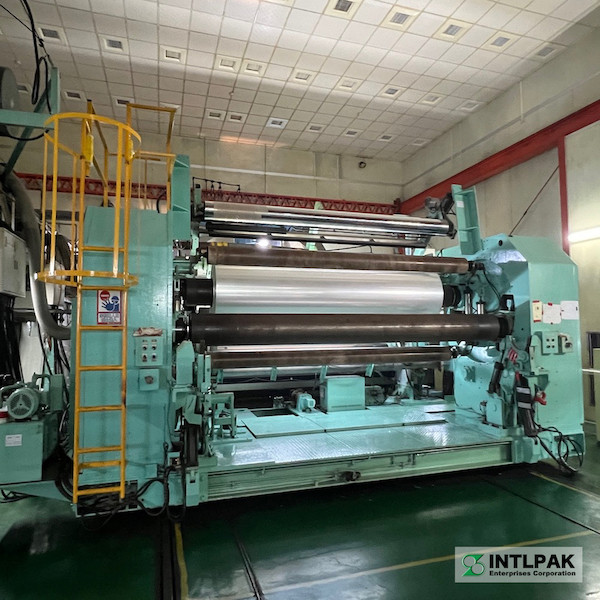
Product Photo
High Barrier PP/EVOH/PP Film
PVP 40 coextrusion film with high oxygen barrier, fragrance retention, and transparency. Corona-treated on one side for lamination with PET, OPP, or NY into food, medical, and cosmetics packaging structures.
High-Toughness, High-Barrier PP Coextrusion Film
F1302 (PVP #40) is the lightest-gauge entry point in Intlpak's PVP high-barrier PP family. Using a PP layer in place of PE gives this line notably higher elongation and toughness than the PE/EVOH/PE (EVE) series at an equivalent gauge, while the EVOH core carries the oxygen barrier and fragrance retention.
Where F1302 Is Used
- 1 Food, medical care, cosmetics, and hygienic cleaning product packaging
- 2 Applications requiring high oxygen-barrier properties with greater film flexibility
- 3 Can be printed or laminated with other film materials
- 4 Modified Atmosphere Packaging (MAP) of fresh beef, chicken, pork, and seafood products
Full Specifications — High Barrier PP Film Series
F1302 is the 40μm grade in Intlpak's PVP high barrier PP/EVOH/PP film family. The table below shows F1302 alongside its 55μm and 70μm siblings for reference.
| Property | Standard | Unit | F1302 (40μm) | F1355 (55μm) | F1307 (70μm) |
|---|---|---|---|---|---|
| Thickness | — | μm | 40 | 55 | 70 |
| Yield Point (MD) | ASTM D882 | kg/cm² | 200 | 190 | 180 |
| Yield Point (TD) | ASTM D882 | kg/cm² | 190 | 190 | 180 |
| Break Point (MD) | ASTM D882 | kg/cm² | 400 | 400 | 400 |
| Break Point (TD) | ASTM D882 | kg/cm² | 380 | 350 | 350 |
| Elongation (MD) | ASTM D882 | % | 600 | 700 | 700 |
| Elongation (TD) | ASTM D882 | % | 600 | 700 | 700 |
| Tensile Modulus 2% (MD) | ASTM D882 | kg/cm² | 5000 | 4300 | 4200 |
| Tensile Modulus 2% (TD) | ASTM D882 | kg/cm² | 4800 | 4300 | 4000 |
| Static C.O.F. (treated) | ASTM D1894 | kg/200g | 0.10 | 1.30 | 0.25 |
| Static C.O.F. (untreated) | ASTM D1894 | kg/200g | 0.08 | 0.15 | 0.20 |
| Kinetic C.O.F. (treated) | ASTM D1894 | kg/200g | 0.07 | 1.20 | 0.15 |
| Kinetic C.O.F. (untreated) | ASTM D1894 | kg/200g | 0.05 | 0.10 | 0.15 |
| Haze | ASTM D1003 | % | 5 | 7 | 6 |
| Oxygen Transmission Rate | ISO 14663-2 | cc/m²·24h, atm, 20°C, 65% RH | 2.6 | 2.6 | 2.6 |
| Water Vapor Transmission Rate | ASTM E96-E | g/m²·24h, 40°C, 90% RH | 6.5 | 5.1 | 3.7 |
| Width | — | — | Customized | ||
| Length | — | — | Customized | ||
Reviewed by: Intlpak R&D Team.
Why F1302 Performs
Storage Notice
Avoid exposure to direct light, wind, and rain — store under appropriate conditions. Prevent products from slipping from high places, being polluted, or being impacted during handling.
Quality & Certification
Manufactured under ISO 9001 quality management and GMP clean-room production, with ISO 22000 & HACCP food-safety certification. All products undergo annual safety checks.
Questions About F1302
F1302 is the thinnest PP/EVOH/PP grade at 40 μm — how does it compare to PE at the same gauge?
It comes down to toughness versus clarity. Using PP layers instead of PE gives F1302 elongation of 600%/600%, clearly above the PE grades at equivalent gauge, while its haze — now measured at 5% — is essentially on par with the roughly 4–5% haze of the PE family at the same gauge, so there's no meaningful clarity trade-off either way. Choose F1302 where the pack must flex and fold without failing, and F1249 or F1201 where PE's moisture barrier is the priority.
F1302, F1355 and F1307 all read OTR 2.6 — does added gauge do nothing?
Nothing for oxygen; a great deal for moisture. All three share the same EVOH barrier layup, holding OTR at 2.6 cc/m²·24h, but water vapour transmission drops sharply with gauge — 6.5 for F1302 at 40 μm, 5.1 for F1355 at 55 μm, and just 3.7 g/m²·24h for F1307 at 70 μm. In this family thickness buys moisture protection and strength, not oxygen barrier.
If I need tighter oxygen barrier than 2.6, which family should I move to?
PE/EVOH/PE or NY/EVOH. F1256 reaches 0.65, F1201 0.9, and F1154 goes to 0.31 cc/m²·24h. The PP/EVOH/PP line is built for toughness and heat tolerance rather than extreme oxygen barrier — if oxidation governs your shelf life, changing family works and adding gauge within this one will not.
What packaging uses F1302?
Flexible packaging for food, medical care, cosmetics and hygienic cleaning products, especially where high barrier must coexist with a pliable web. In fresh protein it serves Modified Atmosphere Packaging of beef, pork, poultry and seafood. It prints directly and laminates to other films for composite structures.
F1302 breaks at 400/400 in both directions — why does that matter?
Because its failure behaviour is direction-independent. Most films show a clear MD/TD gap ( F1648-EPL runs 400/290), whereas F1302 is even, with matching 600%/600% elongation. When packs are stressed unpredictably — gas flushing, stacking, handling — an isotropic web fails more predictably, which makes design margin easier to set.