Product Photo
Nylon (PA) Thermoforming Film — Medical Care Package F2703 (110μm)
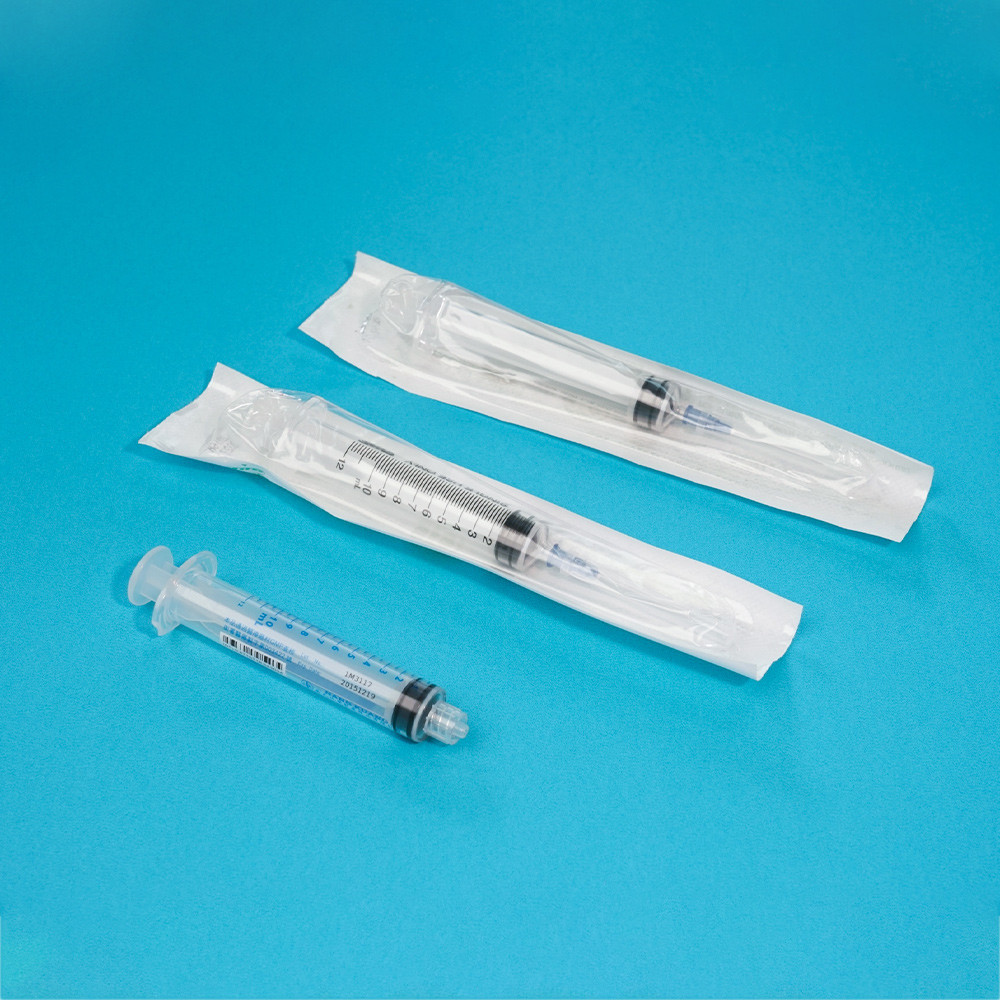
F2703 is a 110μm NY/PE vacuum thermoforming base film built for pinhole resistance and high formability across a 20–40mm forming-depth range, packaging injection syringes, gauze, cotton pads, and suction tubes for either E.O. or gamma (r-ray) sterilization.
A Mid-Gauge Base Film With a Wide Forming-Depth Range
F2703 sits at 110μm in Intlpak's NE medical series, covering a wide 20–40mm forming-depth range in a single gauge — one film for lines that would otherwise stock two. It is produced by computer-controlled co-extrusion with automatic foreign-object detection and thickness control under clean-room standards, and is engineered specifically for pinhole resistance, holding shape around device contours without the weak spots that would compromise a sterile barrier.
Where F2703 Is Used
- 1
Vacuum Thermoforming Base Film
Vacuum thermoforming base film for disposable medical supplies and medical equipment. F2703 runs at 110μm with a 20–40mm forming-depth window, the widest single range in the NE nylon (PA)/PE series, so one grade covers several tooling depths on the same line.
- 2
Syringe and Gauze Packaging
Injection syringes, gauze, cotton pads, and sputum suction tubes. At 7.0% haze the pack stays legible for stock checks, and elongation 490/470% lets the web draw into deeper cavities without thinning to a pinhole.
- 3
Medium to Deep Forming Profiles
Medical devices spanning medium to deeper forming profiles (20–40mm). Break point 450/400 kg/cm² and tensile modulus 2200/2800 kg/cm² give the drawn cavity enough wall strength to protect bulkier instrument sets in transit.
- 4
E.O. and Gamma Sterilization
Packaging lines requiring E.O. (ethylene oxide) or gamma (r-ray) sterilization compatibility. Both routes are supported on the same base film. Intlpak manufactures under ISO 9001, ISO 22000, HACCP and GMP clean room conditions; sterile barrier validation belongs to the device maker.
Full Specifications — Nylon/PE Medical Thermoforming Film Series
F2703 is the 110μm mid-gauge grade in Intlpak's NE nylon/PE medical thermoforming film family — a 110 micron NY/PE forming film for a 20–40mm forming depth, with 7.0% haze and pinhole resistance across the range, suitable for E.O. or gamma (r-ray) sterilization. The table below shows F2703 alongside the 80–150μm grades in the same series.
| Property | Standard | Unit | F2624-M (80μm) | F2703 (110μm) | F2615-M (120μm) | F2606-M (150μm) |
|---|---|---|---|---|---|---|
| Thickness | — | μm | 80 | 110 | 120 | 150 |
| Yield Point (MD) | ASTM D882 | kg/cm² | 150 | 160 | 130 | 180 |
| Yield Point (TD) | ASTM D882 | kg/cm² | 150 | 150 | 140 | 170 |
| Break Point (MD) | ASTM D882 | kg/cm² | 460 | 450 | 320 | 430 |
| Break Point (TD) | ASTM D882 | kg/cm² | 470 | 400 | 330 | 450 |
| Elongation (MD) | ASTM D882 | % | 480 | 490 | 450 | 510 |
| Elongation (TD) | ASTM D882 | % | 550 | 470 | 500 | 560 |
| Tensile Modulus 2% (MD) | ASTM D882 | kg/cm² | 2400 | 2200 | 2400 | 3400 |
| Tensile Modulus 2% (TD) | ASTM D882 | kg/cm² | 2300 | 2800 | 2300 | 3000 |
| Static C.O.F. (untreated) | ASTM D1894 | kg/200g | 0.08 | 0.07 | 0.09 | 0.09 |
| Kinetic C.O.F. (untreated) | ASTM D1894 | kg/200g | 0.08 | 0.06 | 0.08 | 0.09 |
| Haze | ASTM D1003 | % | 5.7 | 7.0 | 10 | 12.5 |
| Suggested Forming Depth | — | mm | 10–15 | 20–40 | 10–30 | 40–50 |
| Corona-Treated Surface | — | — | Nylon side | — | Nylon side | — |
| Formability / Pinhole Resistance | — | — | Best-in-class across the series | |||
| Optical Properties | — | — | High transparency, high gloss | |||
| Sterilization Compatibility | — | — | E.O. and gamma (r-ray) | |||
| Typical Application | — | — | Injection syringes, gauze, cotton pads, suction tubes, and other medical equipment | |||
| Width | — | — | Customized | |||
| Length | — | — | Customized | |||
Reviewed by: Intlpak R&D Team.
Why F2703 Performs
Storage Notice
Avoid exposure to direct light, wind, and rain — store under appropriate conditions. Prevent products from slipping from high places, being polluted, or being impacted during handling.
Quality & Certification
Manufactured under ISO 9001 quality management and GMP clean-room production standards suited to medical-grade packaging, with ISO 22000 & HACCP certification. All products undergo annual safety checks.
Questions About F2703
F2703 and F2615-M are both mid-gauge — how do I choose?
By cavity depth, not gauge. F2615-M (120 μm) covers 10–30 mm and F2703 (110 μm) covers 20–40 mm, so they overlap only between 20 and 30 mm. Below 20 mm use F2615-M; above 30 mm use F2703. Inside the overlap F2703 reaches the same depth with 10 μm less material, so it is the more efficient choice — though if an existing process is already validated on F2615-M, 10 μm rarely justifies re-qualification.
Which sterilization methods does F2703 support?
Both E.O. and gamma (r-ray), consistent with the rest of the nylon medical family. That dual compatibility lets one packaging structure serve different markets or product lines without stocking a separate film for each sterilization route.
What role does F2703 play in a sterile pack?
Bottom web: thermoformed into the cavity that carries the device, then sealed to a breathable top web — dialysis paper or Tyvek — to complete the sterile barrier system. The film alone is not the barrier; seal integrity, top-web breathability and the sterilization process determine the outcome together.
Drawing 110 μm to 30 mm — is wall thickness sufficient?
Within the rated range the design works, but measure rather than assume near the 30 mm limit. Drawn corners are both the thinnest section and the likeliest point of sterile barrier failure. Measure actual corner wall thickness during process validation and, if margin is tight, increase tooling radii or move to F2615-M for extra material.
Which devices suit F2703?
Medium-depth cavities — catheters, syringe sets, small instrument packs. For shallower work use F2624-M (80 μm, 10–15 mm); for deeper, F2606-M (150 μm, 40–50 mm). The family is tiered by forming depth, so selection starts by measuring the cavity.
Our device does not fit a 15 mm cavity but 30 mm wastes material — what covers the middle?
F2703 exists for exactly that band. At 110 μm it is rated for a 20–40 mm forming depth, sitting between the 80 μm grade (10–15 mm) and the 120 μm grade (10–30 mm), with 7.0% haze and pinhole resistance across the range. Matching cavity depth to the rated range avoids both over-thinning at the corners and paying for gauge you never draw.
Where do pinholes usually appear in a thermoformed medical pack?
At the corners and along the draw walls, where the film thins most, and around any rigid edge of the device itself. F2703 is built for pinhole resistance across its full 20–40 mm range, but the practical checks are the same on any grade: keep the draw inside the rated depth, radius sharp tooling corners, and inspect the deepest corner first when validating a new cavity.