Product Photo
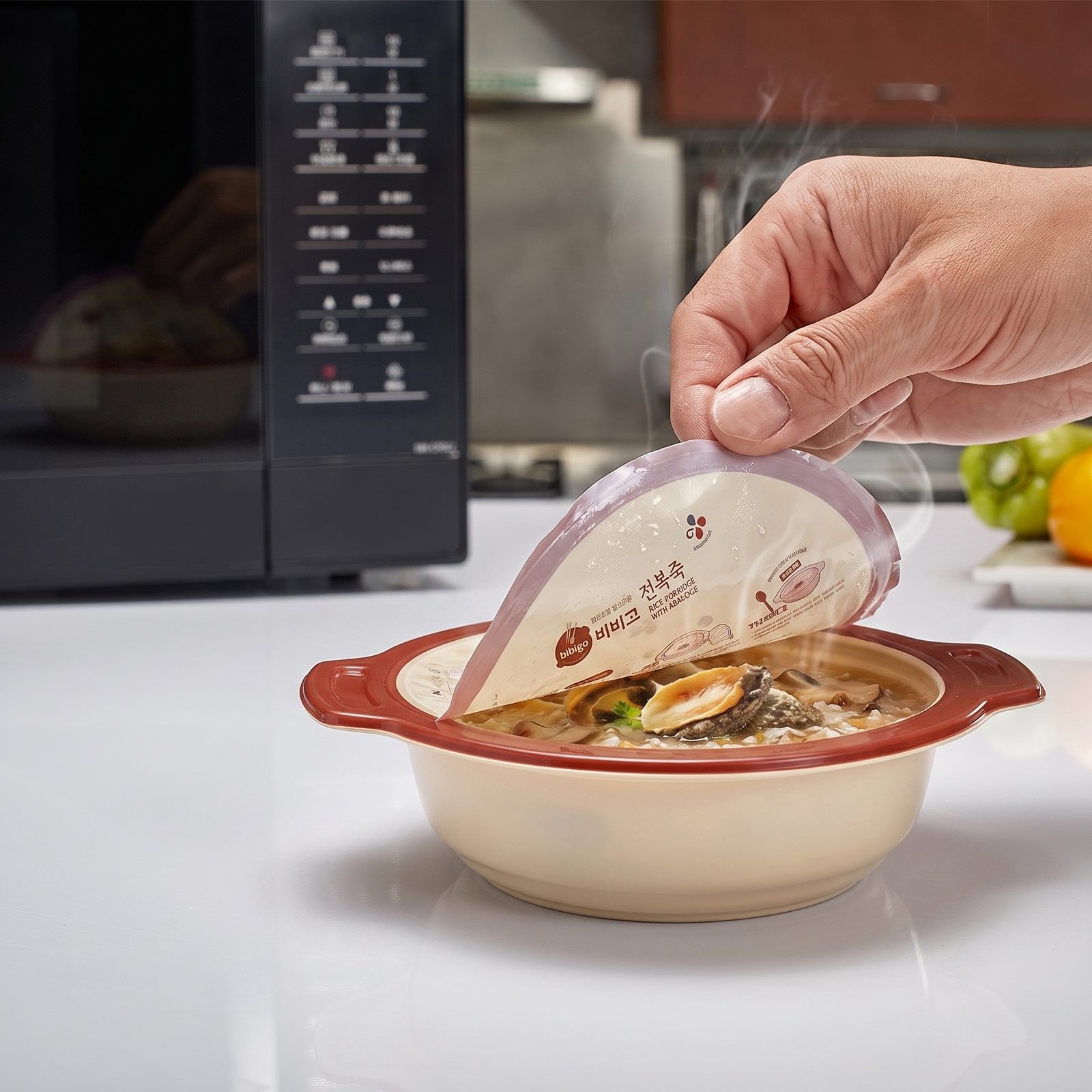
Easy Peel Film for Retort Food F4531 (30μm)
Easy-peel retort lidding film for PP food containers. The lightest-gauge grade in Intlpak's easy-peel lidding series, resisting pressurized high-temperature sterilization from 121°C to 130°C while opening cleanly by hand.
The Entry-Gauge Grade in Intlpak's Easy-Peel Lidding Series
F4531 works as the food-contact heat-seal layer of the laminate; after lamination it becomes the easy-open lid material for PP containers. As the entry gauge alongside F45A5 (50μm) and F45A7 (70μm), it gives converters a lower-cost lidding option for applications that don't need the thicker grades' extra stiffness, while still holding up to pressurized retort sterilization from 121°C to 130°C.
Where F4531 Is Used
- 1
Lid Material for Retort Food
Lid material for retort food. F4531 is the 30μm entry gauge in the easy-peel lidding series, sealing to PP containers at 3.2 kg/cm² for one second and holding through the 121°C, 30-minute sterilization used as the test condition.
- 2
High-Temperature Processed Food
High-temperature processed food packaging containers. Rated for pressurized sterilization from 121°C to 130°C, so a filled tray can be cooked and sterilized after sealing instead of being filled with pre-sterilized contents.
- 3
Heat-Seal Layer After Lamination
Heat-seal layer for lid material after lamination. The recommended structure is PET 12μm // AL 9μm // ONY 15μm // EO-RCPP 30μm — F4531 is the innermost sealant, with the foil and PET layers carrying barrier and print.
- 4
Sealing to PP Containers
Suitable for PP (polypropylene) packaging containers. Peel occurs at the film-to-PP interface, so lid and container work as a matched pair; tensile modulus 5500/5200 kg/cm² keeps the web stable through die-cutting and lidding.
- 5
Pet Food and Ready Meals
Pet food, canned food, microwaveable food, and ready-to-eat meals — retail formats where a sealed tray replaces a metal can and still has to open by hand at the table.
- 6
Clean Hand-Peel Opening
A clean opening experience at the consumer end: the lid lifts away by hand without tearing or stringing, and at 8.0% haze F4531 is the clearest of the three gauges for structures that stay transparent.
Full Specifications — EO-RCPP Easy Peel Film Series
F4531 is the 30μm grade in Intlpak's EO-RCPP easy peel film family — a 30 micron easy peel lidding film for PP food containers, resisting pressurized sterilization from 121°C to 130°C, with 8.0% haze, the lowest in the series. The table below shows F4531 alongside its 50μm and 70μm siblings for reference.
| Property | Standard | Unit | F4531 (30μm) | F45A5 (50μm) | F45A7 (70μm) |
|---|---|---|---|---|---|
| Thickness | — | μm | 30 | 50 | 70 |
| Yield Point (MD) | ASTM D882 | kg/cm² | 240 | 240 | 240 |
| Yield Point (TD) | ASTM D882 | kg/cm² | 220 | 220 | 220 |
| Break Point (MD) | ASTM D882 | kg/cm² | 610 | 550 | 520 |
| Break Point (TD) | ASTM D882 | kg/cm² | 330 | 350 | 420 |
| Elongation (MD) | ASTM D882 | % | 590 | 700 | 770 |
| Elongation (TD) | ASTM D882 | % | 650 | 800 | 830 |
| Tensile Modulus 2% (MD) | ASTM D882 | kg/cm² | 5500 | 5600 | 5600 |
| Tensile Modulus 2% (TD) | ASTM D882 | kg/cm² | 5200 | 5400 | 5500 |
| Static C.O.F. (corona treated) | ASTM D1894 | kg/200g | 0.78 | 0.70 | 0.80 |
| Static C.O.F. (untreated) | ASTM D1894 | kg/200g | 0.21 | 0.27 | 0.26 |
| Kinetic C.O.F. (corona treated) | ASTM D1894 | kg/200g | 0.64 | 0.65 | 0.74 |
| Kinetic C.O.F. (untreated) | ASTM D1894 | kg/200g | 0.19 | 0.25 | 0.25 |
| Haze | ASTM D1003 | % | 8.0 | 12.9 | 13.7 |
| Width | — | — | Customized | ||
| Length | — | — | Customized | ||
| Recommended Structure | PET 12μm // AL 9μm // ONY 15μm // EO-RCPP 30μm | ||||
|---|---|---|---|---|---|
| Heat Seal Condition | Pressure 3.2 kg/cm², Time 1 sec | ||||
| Sterilization Condition (test) | Temperature 121°C, Time 30 min | ||||
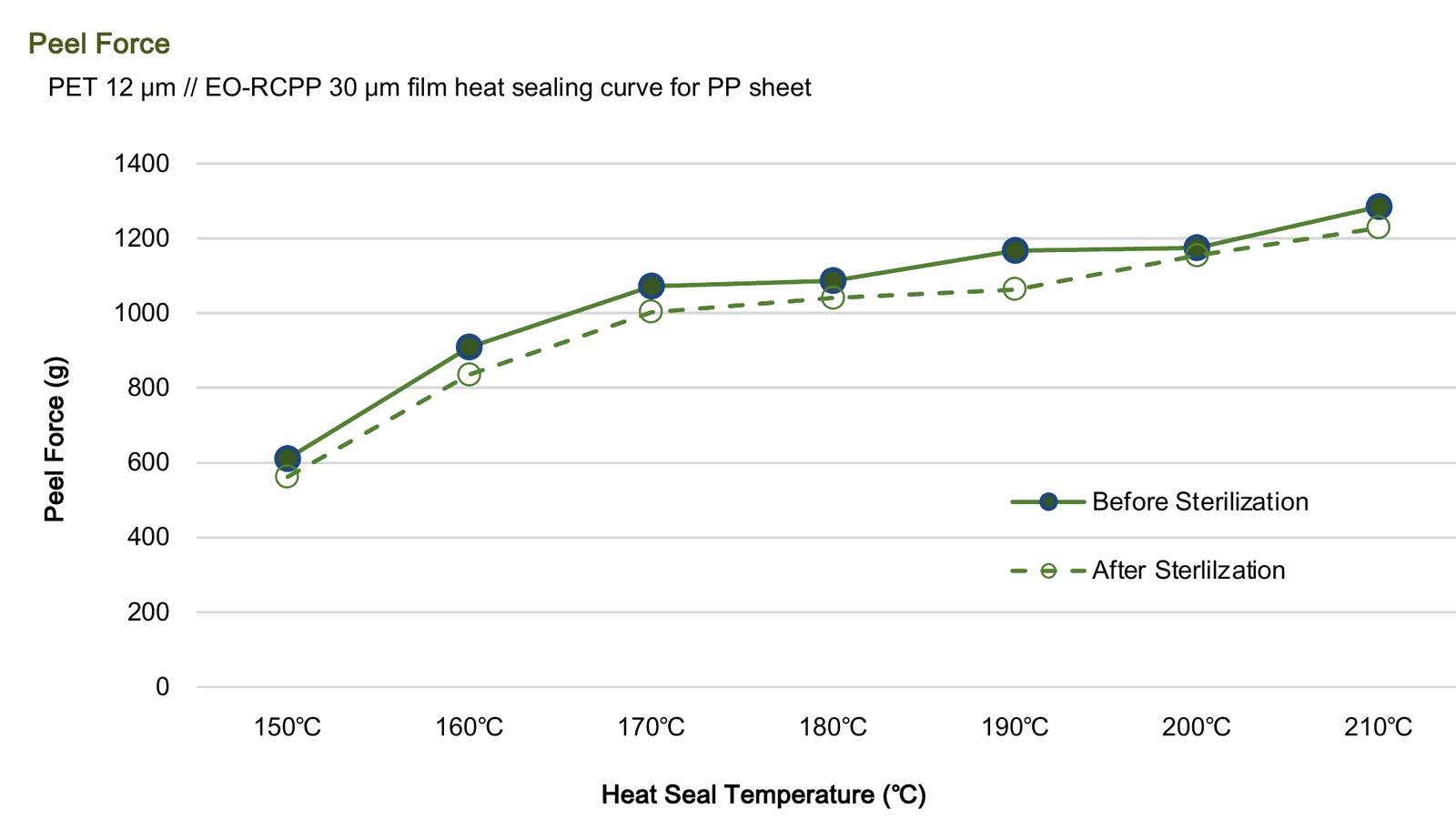
Peel Force vs. Heat Seal Temperature (F4531, 30μm)
Structure tested: PET 12μm // EO-RCPP 30μm film heat sealing curve for PP sheet. Heat seal conditions: pressure 3.2 kg/cm², time 1 sec. Sterilization condition: 121°C, 30 minutes. Across the tested range of 150°C–210°C heat seal temperature, peel force increases steadily with sealing temperature both before and after sterilization, and the post-sterilization curve tracks slightly below the pre-sterilization curve at every point — indicating the film retains consistent, predictable peel strength after retort sterilization rather than degrading unpredictably. Exact force values per temperature point are available from Intlpak on request.
Reviewed by: Intlpak R&D Team.
Why Converters Choose F4531
Storage Notice
Avoid exposure to direct light, wind, and rain — store under appropriate conditions. Prevent products from slipping from high places, being polluted, or being impacted during handling.
Quality & Certification
Manufactured under ISO 9001 quality management and GMP clean-room production, with ISO 22000 & HACCP food-safety certification. All products undergo annual safety checks.
Questions About F4531
What separates F4531, F45A5 and F45A7 — which should I choose?
All three are EO-RCPP easy-peel lidding films differing only in gauge: F4531 at 30 μm, F45A5 at 50 μm, F45A7 at 70 μm, with the same 121–130°C rating and the same recommended laminate. When your lid needs no extra stiffness, F4531 is the lowest-cost entry point; step up for more rigidity or a larger container opening.
At only 30 μm, does F4531 survive 121–130°C pressurized retort?
Yes. It is tested at 121°C for 30 minutes under pressure, and across the full 150–210°C seal range the post-sterilization peel-force curve sits only slightly below the pre-sterilization curve with the same upward trend — peel strength stays consistent and predictable, with no sudden drop-off. Its heat rating matches F45A5 and F45A7 ; gauge does not move the temperature ceiling.
What heat-seal settings does F4531 need, and how wide is its window?
Standard conditions are 3.2 kg/cm² pressure for 1 second; the tested seal range is 150–210°C with peel force rising steadily across it. The sealing window exceeds 30°C, so seal quality holds even when line temperature drifts — fewer rejects.
What must F4531 be laminated with, and what containers does it seal to?
The recommended structure is PET 12 μm // AL 9 μm // ONY 15 μm // EO-RCPP 30 μm. F4531 serves as the food-contact heat-seal layer; once laminated it becomes the complete lid material. It seals to PP (polypropylene) containers — retort meals, pet food, canned food and microwaveable ready-to-eat trays.
F4531 has the series' lowest haze at 8.0% — what does that buy me?
Thinner film, higher clarity. At 8.0% haze (ASTM D1003) it reads well below F45A5 at 12.9% and F45A7 at 13.7%, making it the clearest of the three when the lid must show the contents. It also carries the series' highest MD break point at 610 kg/cm², giving the best resistance to machine-direction tearing.
How do we make a sealed food pack easier for customers to open?
Change the sealant layer, not just the seal pressure. An easy-peel film is built to separate cleanly at a controlled force, so the lid lifts by hand without scissors or tearing. F4531 is the 30 μm grade in Intlpak's EO-RCPP easy-peel range, still resisting pressurized sterilization from 121°C to 130°C, at 8.0% haze — the clearest of the three food grades.
What is the thinnest lidding film we can use on a retort tray?
Within Intlpak's easy-peel range the floor is F4531 at 30 μm, and it still clears 121–130°C pressurized sterilization. Thinner means less material per pack, but less margin for handling and for uneven container flanges. The 50 μm and 70 μm grades buy elongation — 700%/800% and 770%/830% against F4531's 590%/650% — which matters where trays vary or lines run fast.