Product Photo
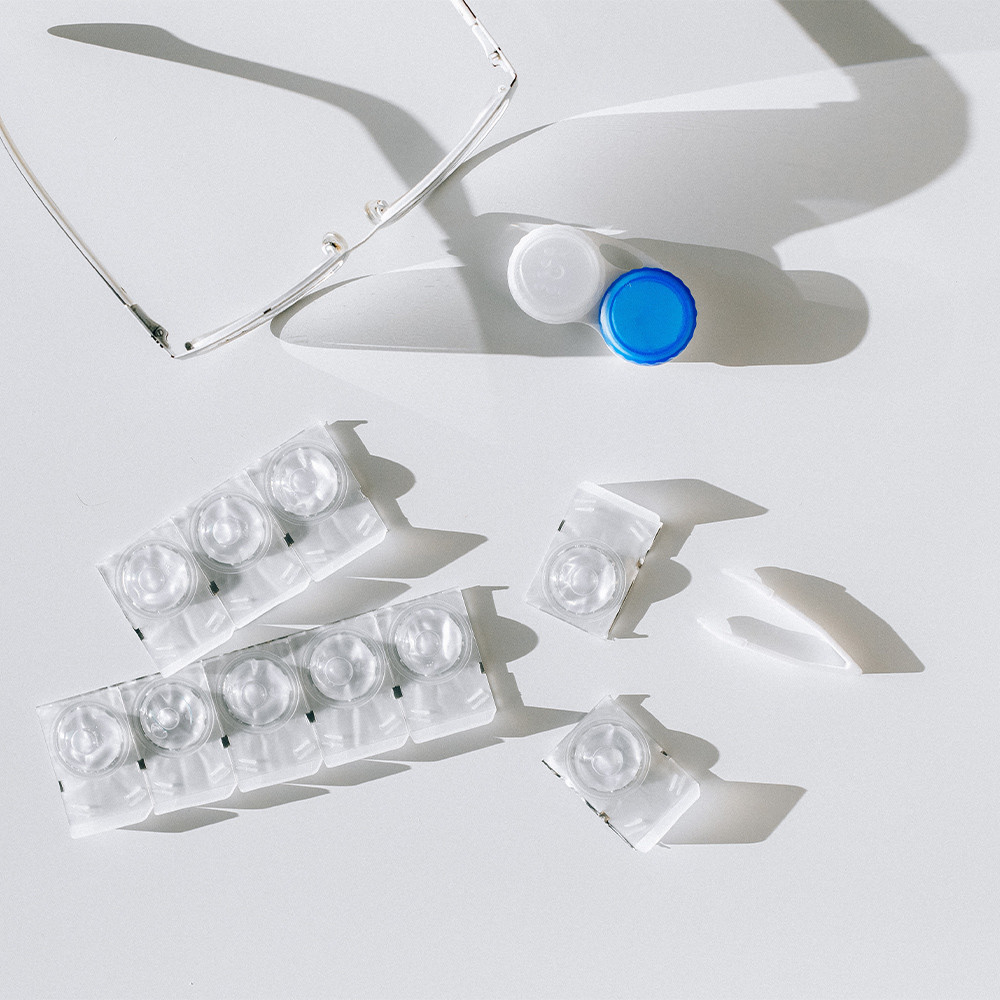
Easy Peel Film for Contact Lens F4568 (35μm)
Precision easy-peel sealing film for contact lens blister containers. Withstands pressurized high-temperature sterilization to 130°C while keeping peel force stable and consistent, safe and hygienic for direct product contact.
A Purpose-Built Easy-Open Lid for Contact Lens Containers
Laminated into a structure such as PET 12μm // AL 9μm // ONY 15μm // EO-RCPP 35μm, F4568 becomes the product-contact heat-seal layer of a contact lens blister. The formulation targets the narrow requirement that defines this application: a low, fingertip-openable peel force that stays within a small, predictable range before and after sterilization, so the saline solution inside doesn't splash on opening. Converters get a heat-sealing window of over 30°C to work with on the line.
Where F4568 Is Used
- 1
Contact Lens Blister Lidding
High-temperature sterilization lid material for contact lens containers. F4568 is the 35μm gauge, sealing the blister that holds the lens and its solution and staying intact through pressurized sterilization to 130°C.
- 2
Heat-Seal Layer After Lamination
Heat-seal layer for lid material after lamination. The recommended structure is PET 12μm // AL 9μm // ONY 15μm // EO-RCPP 35μm — the foil layer provides the barrier while F4568 provides the seal and the peel.
- 3
Sealing to PP Blister Containers
Suitable for PP (polypropylene) contact lens packaging containers. Tensile modulus 6900/6600 kg/cm² is the highest of any Intlpak easy-peel grade, which is what allows the small, precisely die-cut lids a lens blister needs.
- 4
Heat Resistant to 130°C
Heat resistant up to 130°C. Lens blisters are sterilized with the product already sealed inside, so peel force has to stay stable and consistent after the autoclave, not only before it.
Full Specifications — EO-RCPP Contact Lens Easy Peel Film Series
F4568 is the 35μm grade in Intlpak's EO-RCPP contact lens easy peel film family — a 35 micron easy peel film for contact lens blister containers, resisting pressurized sterilization to 130°C with peel force that stays stable before and after autoclaving, at 33% haze. The table below shows F4568 alongside its 50μm sibling (F4569) for reference.
| Property | Standard | Unit | F4568 (35μm) | F4569 (50μm) |
|---|---|---|---|---|
| Thickness | — | μm | 35 | 50 |
| Yield Point (MD) | ASTM D882 | kg/cm² | 270 | 280 |
| Yield Point (TD) | ASTM D882 | kg/cm² | 250 | 250 |
| Break Point (MD) | ASTM D882 | kg/cm² | 640 | 620 |
| Break Point (TD) | ASTM D882 | kg/cm² | 410 | 430 |
| Elongation (MD) | ASTM D882 | % | 670 | 790 |
| Elongation (TD) | ASTM D882 | % | 710 | 790 |
| Tensile Modulus 2% (MD) | ASTM D882 | kg/cm² | 6900 | 7200 |
| Tensile Modulus 2% (TD) | ASTM D882 | kg/cm² | 6600 | 6900 |
| Static C.O.F. (corona treated) | ASTM D1894 | kg/200g | 0.60 | 0.54 |
| Static C.O.F. (untreated) | ASTM D1894 | kg/200g | 0.70 | 0.60 |
| Kinetic C.O.F. (corona treated) | ASTM D1894 | kg/200g | 0.48 | 0.43 |
| Kinetic C.O.F. (untreated) | ASTM D1894 | kg/200g | 0.47 | 0.45 |
| Haze | ASTM D1003 | % | 33 | 38 |
| Width | — | — | Customized | |
| Length | — | — | Customized | |
| Recommended Structure | PET 12μm // AL 9μm // ONY 15μm // EO-RCPP 35μm | |||
|---|---|---|---|---|
| Heat Resistance | Up to 130°C | |||
Reviewed by: Intlpak R&D Team.
Why Converters Choose F4568
Storage Notice
Avoid exposure to direct light, wind, and rain — store under appropriate conditions. Prevent products from slipping from high places, being polluted, or being impacted during handling.
Quality & Certification
Manufactured under ISO 9001 quality management and GMP clean-room production, with ISO 22000 & HACCP food-safety certification. All products undergo annual safety checks.
Questions About F4568
F4568 and F4569 both lid contact lens blisters — 35 or 50 μm?
Most contact lens blisters run fine on the 35 μm F4568, because this application is defined by a low, repeatable peel force rather than by strength. Move to F4569 (50 μm) when you need more stiffness — larger blisters, or automated handling sensitive to web tension. Both carry the same 130°C rating and the same laminate structure; gauge and modulus are the difference.
Why does a contact lens lidding film need such a low peel force?
Because there is saline inside the blister. Too much peel force and the container jolts as the user pulls, splashing the solution; too little and the lid can creep open in transit. F4568's formulation targets exactly that narrow band — a small, predictable peel force before and after sterilization, openable with a fingertip.
How wide is F4568's sealing window on a live line?
Over 30°C. That matters disproportionately here: lens blisters run multi-cavity tooling where cavity-to-cavity temperature is never perfectly even, and a window above 30°C keeps that spread from leaving some cavities under-sealed and others impossible to open.
What does F4568 seal to, and what does it laminate into?
It seals to PP contact lens blisters and withstands sterilization to 130°C. The film itself is the innermost layer of a composite: working outward, ONY 15 μm, aluminium foil 9 μm and PET 12 μm sit above it. The foil is doing more than blocking oxygen here — it also keeps the saline inside from degrading through light exposure or moisture loss.
F4568's haze is 33%, far above the food easy-peel grades — is that a problem?
No. This series laminates to aluminium foil, so the lid is opaque by design and haze does not reach the finished pack. The number that matters is modulus: F4568 measures 6900/6600 kg/cm² MD/TD against roughly 5500/5200 for the food easy-peel films, and that rigidity is what keeps the web dimensionally stable through high-speed blister sealing.
What film seals a contact lens blister?
A precision easy-peel film that survives autoclaving. F4568 is the 35 μm EO-RCPP grade for contact lens blister containers, resisting pressurized sterilization to 130°C while keeping peel force stable before and after the cycle. It seals to PP lens containers and laminates into a PET/AL structure. Peel consistency matters more here than clarity — haze reads 33%.
Our blister lids sometimes tear instead of peeling — what causes that?
Usually a seal that is stronger than the film's own tear resistance, so the web fails before the interface does. An easy-peel film is engineered to fail at the seal interface first, at a controlled force. F4568 holds that behaviour through 130°C sterilization. If tearing persists, check seal temperature and dwell before changing film — an over-sealed easy-peel behaves like a weld.